AGICY vs CoreWeave: Sovereign AI Infrastructure for the Post‑CLOUD Act Era
CoreWeave proved that dedicated GPU cloud beats hyperscaler shared tenancy. AGICY designs for a similar reserved-capacity product shape — SRAs as forward capacity reservations — inside an EU-sovereign, RISC-V-native architecture with zero US legal nexus. Executed offtake today is zero; this is not a claim of contracted take-or-pay backlog equivalent to CoreWeave.
TL;DR
CoreWeave proved the neo-cloud model works. A $19B IPO in March 2025 that grew to a $62B market cap. $66.8B in contracted backlog.1 The thesis is validated: dedicated GPU cloud beats hyperscaler shared tenancy, take-or-pay contracts create bankable revenue, and purpose-built AI infrastructure commands premium economics.
AGICY designs for a similar reserved-capacity product shape — forward capacity reservations (SRAs), infrastructure purpose-built for AI workloads — but in an EU-sovereign, RISC-V-native architecture with zero US legal nexus. Product design is not the same as executed backlog: AGICY offtake executed today = 0.
Different chips. Different jurisdiction. Similar product mechanics once contracts are signed — not equivalent economics today.
Proof that take-or-pay compute contracts can be bankable when executed. AGICY's SRA model targets a related 36-month forward capacity reservation structure inside EU jurisdiction with RISC-V silicon — a design target, not a claim of CoreWeave-scale contracted backlog today.
What CoreWeave Got Right
Credit where credit is due. CoreWeave built a category. Before CoreWeave, the assumption was that AI compute belonged to hyperscalers — AWS, Azure, GCP. CoreWeave proved otherwise, and the market responded.
- $19B IPO (March 2025): The largest tech IPO of 2025, validating the dedicated GPU cloud thesis. Market cap grew to $62B within months.1
- Take-or-pay contracts:CoreWeave pioneered long-term, committed compute agreements in the AI cloud space. Customers commit to capacity; CoreWeave commits to availability. This creates predictable, bankable revenue — the same structure oil & gas companies use for pipeline capacity.
- NVIDIA partnership: Deep allocation relationship with NVIDIA gave CoreWeave supply certainty when GPUs were allocation-constrained. First-mover advantage in securing H100 and B200 supply.
- $66.8B contracted backlog:Not revenue —committed future revenue. This is the metric that made CoreWeave financeable. Banks will lend against committed backlog.2
- Purpose-built infrastructure:CoreWeave didn't try to be a general-purpose cloud. Every architecture decision was optimised for GPU workloads. Networking, cooling, power delivery — all purpose-built for AI.
“CoreWeave proved that AI infrastructure is not a feature of cloud computing — it is its own category. The question is no longer whether dedicated GPU cloud works. The question is where.”
Where CoreWeave Falls Short for EU Enterprises
CoreWeave's model works. The problem isn't the economics — it's the jurisdiction. For EU enterprises operating under GDPR, NIS2, DORA, and the EU AI Act, CoreWeave has structural gaps that no amount of engineering can fix:
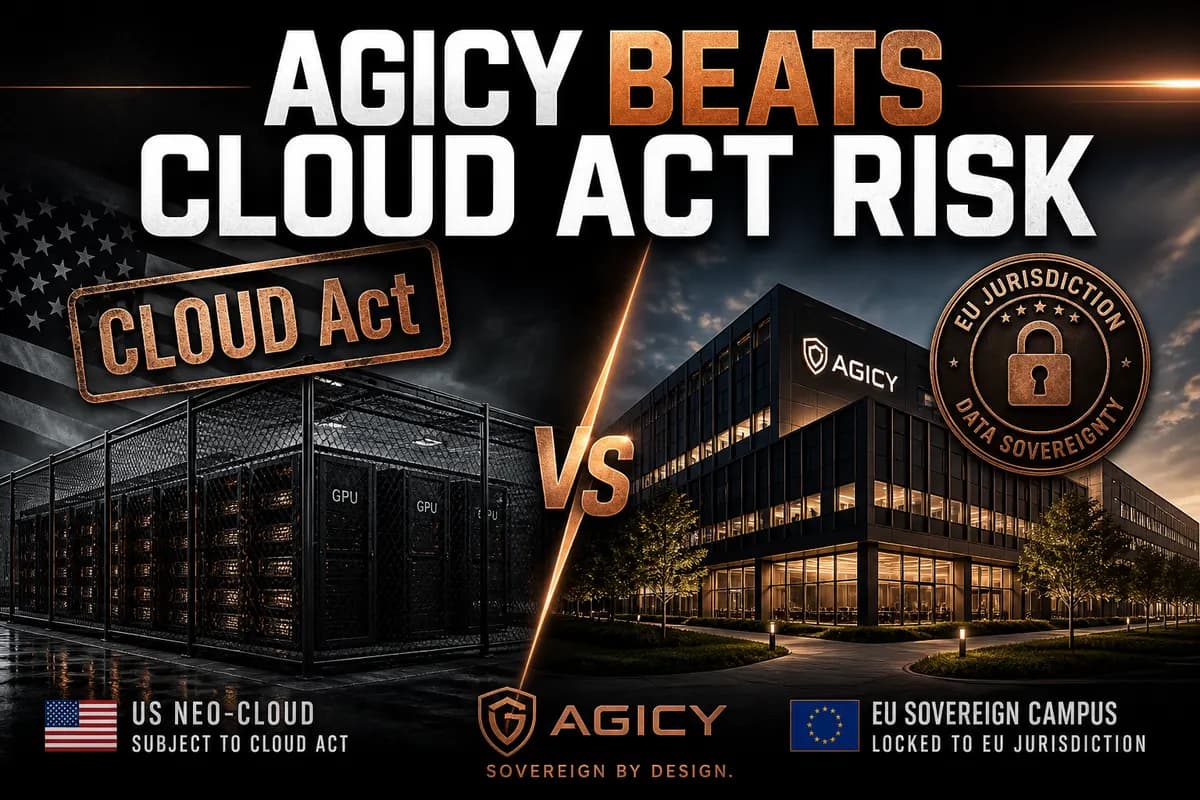
- US jurisdiction → CLOUD Act exposure: CoreWeave is a US-incorporated company. Under the Clarifying Lawful Overseas Use of Data Act (2018), US authorities can compel access to data held by US companies regardless of where that data is physically stored.3 Even if CoreWeave operates EU data centres, the legal nexus is American.
- 100% NVIDIA dependency:CoreWeave's entire fleet is NVIDIA. Every GPU, every software stack, every performance claim depends on a single US-headquartered vendor subject to US export controls and supply allocation decisions.
- No EU sovereignty:CoreWeave has no EU-domiciled operating entity with independent governance. “EU region” does not equal EU sovereignty. Data localisation is not the same as legal independence.
- No on-chain compliance: CoreWeave uses traditional enterprise contracting. No verifiable inference logs, no on-chain SLA enforcement, no smart-contract governance. Compliance is trust-based, not cryptographically verifiable.
- No IP Box benefit: CoreWeave clients pay US corporate tax rates on IP developed using CoreWeave infrastructure. There is no structural tax optimisation pathway for qualifying AI intellectual property.
A US-incorporated company operating EU data centres is still a US company. The CLOUD Act applies to the company, not the data centre. For EU enterprises in regulated sectors — finance, healthcare, civil protection, critical infrastructure — this is not a policy nuance. It is a compliance disqualifier.
Head-to-Head Comparison
Fifteen dimensions that matter for AI infrastructure procurement. Not marketing — architecture, jurisdiction, and economics.
| Dimension | CoreWeave | AGICY |
|---|---|---|
| Jurisdiction | US (Delaware C-Corp) | EU (Cyprus) |
| CLOUD Act Exposure | Yes — US entity | None — no US legal nexus |
| Chip Vendor | NVIDIA (H100, B200, B300) | Tenstorrent Galaxy (Blackhole RISC-V) |
| Silicon Lock-In | Single vendor (CUDA ecosystem) | Open ISA — multi-vendor roadmap |
| Power Source | Grid-dependent (varies by site) | 42MW self-generated + grid |
| Sovereignty Level | US-sovereign | EU-sovereign (full stack) |
| Data Sovereignty | Data localisation (not legal independence) | Full EU data jurisdiction under GDPR |
| Compliance Automation | Traditional enterprise (trust-based) | On-chain (SUI smart contracts) |
| IP Box Tax | Not applicable (US jurisdiction) | 3% effective rate on qualifying IP |
| Contract Model | Take-or-pay (enterprise agreements) | SRA — 36-month token reservation |
| Blockchain Layer | None | SUI governance, ETH tokenisation, SKALE agents |
| AI Agent Payments | None — human-only procurement | SKALE-based autonomous agent payments |
| Deployment Model | Multi-region US data centres | EU single-jurisdiction (Cyprus) |
| GPU-aaS Pricing | Per-GPU-hour (NVIDIA rates) | Per-token (SRA-committed pricing) |
| Exit Pathway | Vendor lock-in (CUDA migration cost) | Open ISA — portable to any RISC-V vendor |
| EU AI Act Compliance | Partial — deployer obligations only | Full-stack — auditable hardware + on-chain logs |
The pattern is clear. CoreWeave and AGICY share a related product thesis — dedicated, purpose-built AI infrastructure with reserved capacity can beat hyperscaler shared tenancy — but AGICY does not claim equivalent executed backlog or bankable offtake today (executed = 0). The divergence is also in jurisdiction, silicon independence, and regulatory architecture.
The RISC-V Advantage
CoreWeave's entire fleet is NVIDIA. Every server, every rack, every data centre. This is not a criticism — it was the rational choice in 2020–2024 when NVIDIA was the only game in town for production AI compute. But single-vendor dependency carries structural risk.
AGICY runs Tenstorrent Galaxy servers powered by Blackhole RISC-V accelerators. The advantages are architectural, not incremental:
- No export controls on the ISA: The RISC-V instruction set is an open standard governed by RISC-V International (Swiss non-profit). Unlike CUDA or x86, the ISA itself is not subject to US export licensing. Supply-chain certainty at the architectural layer.4
- Full hardware auditability:Open-ISA silicon can be independently audited at the instruction-set level. For EU AI Act Article 26 compliance — which requires deployer oversight and transparency — this is a structural advantage over proprietary black-box architectures.
- 4.2× better power efficiency:Tenstorrent Galaxy draws ~9 kW per 32-chip server. Comparable NVIDIA H100 deployments require 2–3 servers at ~23 kW for equivalent inference throughput. At scale, the energy cost difference compounds into millions annually.5
- ~$110K/server vs ~$3M DGX: Tenstorrent Galaxy servers are positioned at a fraction of the cost of NVIDIA DGX systems. Lower capital intensity per unit of inference throughput means faster payback and lower financial risk on forward commitments.
- Open-source software stack:TT-Metalium (Apache 2.0) replaces NVIDIA's proprietary CUDA + cuDNN + TensorRT stack. No per-GPU licensing fees. No vendor-controlled software updates. Full stack transparency.
Lower capital intensity means AGICY can design SRA pricing for mid-market enterprises — not just hyperscale customers. Similar reserved-capacity product shape to CoreWeave, with lower HW intensity — not a claim of equivalent contracted economics today.
The IP Box Play
This is the dimension most overlooked in AI infrastructure comparisons. Tax treatment of AI-generated intellectual property directly affects the economics of model development, fine-tuning, and deployment at scale.
CoreWeave clients operate under US tax jurisdiction. AI models developed, fine-tuned, or deployed on CoreWeave infrastructure are subject to standard US corporate tax rates on income derived from that intellectual property.
AGICY clients who build or fine-tune models on sovereign Cyprus infrastructure have access to the Cyprus IP Box regime:
- 3% effective tax rate on qualifying IP income (vs 21% US corporate rate).6
- Qualifying IPincludes patents, copyrighted software, and other intangible assets developed through R&D activity — including AI model weights, fine-tuned architectures, and proprietary inference optimisations.
- Nexus requirement:The IP must be developed using qualifying expenditure in Cyprus. AGICY's sovereign infrastructure provides the physical nexus — compute runs on Cyprus-based servers, establishing the territorial link required for IP Box qualification.
- OECD-compliant:Cyprus's IP Box regime is fully compliant with the OECD's modified nexus approach (BEPS Action 5). This is not a loophole — it is a structured, internationally recognised tax incentive.
| IP Tax Scenario | CoreWeave (US) | AGICY (Cyprus IP Box) |
|---|---|---|
| Corporate tax rate | 21% federal + state | 15% standard |
| IP Box effective rate | N/A (no US IP Box) | ~3% on qualifying IP income |
| Tax on €10M IP income | ~$2.1M+ (federal only) | €300K |
| OECD compliant | N/A | Yes — BEPS Action 5 |
“Build your model on AGICY. Fine-tune it on sovereign infrastructure. Own the IP. Pay 3% tax. This is not tax avoidance — it is tax architecture.”
The Blockchain Difference
CoreWeave has no blockchain layer. No on-chain governance. No verifiable inference. No smart-contract-enforced SLAs. Compliance is trust-based: you sign a contract, and you trust CoreWeave to honour it. Dispute resolution goes through traditional legal channels.
AGICY integrates blockchain at the infrastructure layer — not as a marketing add-on, but as a compliance and governance architecture:
- SUI blockchain — governance: SRA agreements, capacity allocation, and compliance attestations are recorded on SUI. Smart contracts enforce take-or-pay terms automatically. No ambiguity. No manual enforcement.7
- Ethereum — tokenisation:Compute capacity is tokenised as ERC-20 tokens on Ethereum. SRA token holders have cryptographically verifiable claims on future inference capacity. This creates a secondary market for compute capacity — something CoreWeave's traditional contracts cannot offer.
- SKALE — AI agent payments:Autonomous AI agents can procure and pay for inference capacity directly via SKALE's gas-free L2 network. No human intermediary. No enterprise sales process. Agents call the API, the smart contract settles, inference executes.8
- Verifiable inference:Inference logs can be hashed and anchored on-chain, creating cryptographic proof of what model was run, on what data, at what time, producing what output. For regulated sectors (finance, healthcare, legal), this is the difference between “we think we're compliant” and “here is the cryptographic proof.”
The EU AI Act requires deployers to maintain logs, ensure transparency, and demonstrate oversight. Traditional SLA enforcement is reactive — you discover non-compliance after the fact. On-chain compliance is proactive: every inference event is logged, hashed, and verifiable in real time. This is the compliance architecture that regulators will expect.
Book Tokens, Not GPUs
CoreWeave sells GPU-hours. You rent NVIDIA hardware by the hour, week, or month. You pay for GPUs whether or not you use them efficiently. Utilisation is your problem.
AGICY sells compute tokens through Service Reservation Agreements (SRAs). The model is fundamentally different:
- 36-month forward capacity reservation:You commit to a compute allocation over three years. AGICY commits to availability at that capacity. This targets a take-or-pay-style structure of the kind that made CoreWeave bankable — applied at the token level once executed. AGICY offtake executed today = 0.
- Reserved compute tokens (TARGET): Your SRA allocates a specific number of inference tokens per month. You consume tokens when you run inference. Unused tokens roll forward (within contract terms), eliminating the waste of GPU-hour billing.
- No speculative hardware spend:You don't buy GPUs. You don't lease servers. You reserve capacity. AGICY manages the hardware, the cooling, the power, the software stack. You consume inference as a service.
- IP Box qualification pathway:SRA compute usage generates qualifying R&D expenditure for Cyprus IP Box purposes. The compute tokens you consume building and fine-tuning models establish the nexus for 3% effective tax on resulting IP income.
| SRA Tier | Monthly Token Allocation | Term | IP Box Qualification |
|---|---|---|---|
| Starter | 10M inference tokens | 36 months | Eligible (with qualifying R&D activity) |
| Growth | 100M inference tokens | 36 months | Eligible — enhanced nexus |
| Enterprise | 1B+ inference tokens | 36 months | Full qualification — dedicated IP advisory |
| Sovereign | Custom allocation | 36–60 months | Full qualification + dedicated compute cluster |
Every SRA tier includes Copperway access, sovereign data jurisdiction (GDPR-compliant EU hosting), and on-chain SLA enforcement via SUI smart contracts.
“Stop renting GPUs by the hour. Start reserving compute capacity by the contract. Book tokens, not hardware.”
CoreWeave-class product design. EU sovereignty.
AGICY designs for take-or-pay-style reserved capacity inside EU jurisdiction, on RISC-V silicon, with on-chain governance. That is a product architecture — not a claim of CoreWeave-scale contracted backlog today (executed offtake = 0). Express interest in capacity reservation when ready.
Frequently Asked Questions
Is AGICY a CoreWeave competitor?
Not directly. CoreWeave serves the US market with NVIDIA infrastructure. AGICY serves the EU market with RISC-V infrastructure. The economic models are similar — take-or-pay contracts, dedicated compute, purpose-built facilities — but the jurisdictions, chip architectures, and regulatory environments are different. An EU enterprise that cannot use US-jurisdiction infrastructure for compliance reasons is not choosing between CoreWeave and AGICY — CoreWeave was never an option for them.
What about NVIDIA supply? Doesn't CoreWeave have better hardware?
CoreWeave has the latest NVIDIA hardware (H100, B200, B300). For training workloads, NVIDIA retains a decisive advantage. For inference workloads — which constitute 80–90% of production AI compute — Tenstorrent Galaxy is competitive on throughput while delivering 4.2× better power efficiency and dramatically lower capital cost per server. AGICY is not competing on training. AGICY is purpose-built for production inference at scale.
How does the Cyprus IP Box work?
Cyprus offers a tax incentive for qualifying intellectual property income under its IP Box regime. Companies that develop qualifying IP (including AI models, software, and patented technologies) through R&D expenditure in Cyprus can apply an 80% deduction on qualifying IP profits, resulting in an effective tax rate of approximately 3% (vs the standard 15% corporate rate). The regime is fully OECD-compliant under BEPS Action 5's modified nexus approach. AGICY's sovereign infrastructure provides the qualifying expenditure nexus — compute consumed on Cyprus-based servers counts as qualifying R&D spend.
What is an SRA (Service Reservation Agreement)?
An SRA is a 36-month forward commitment to inference compute capacity. Think of it as a “take-or-pay” contract for AI compute tokens. You commit to consuming a minimum volume of inference tokens per month at a locked price. AGICY commits to making that capacity available. The SRA is recorded on-chain via SUI smart contracts, providing cryptographically verifiable terms and automated enforcement. Once executed, SRAs are intended to create bankable, predictable revenue of the kind that made CoreWeave's backlog financeable — but AGICY does not claim equivalent contracted backlog today (executed = 0).
Can I use AGICY alongside CoreWeave or other providers?
Yes. Many enterprises will run training workloads on NVIDIA infrastructure (CoreWeave, hyperscalers) and production inference on AGICY's sovereign RISC-V infrastructure. This is not all-or-nothing. The Copperway is model-agnostic — models trained anywhere can be deployed on AGICY for inference. A hybrid strategy gives you NVIDIA's training performance plus AGICY's sovereignty, power efficiency, and IP Box benefits for production workloads.
Sources & References
- 1 CoreWeave IPO ($19B, March 2025) and subsequent market cap growth to $62B from S-1 filing, NYSE listing data, and Bloomberg/Reuters post-IPO coverage. $66.8B contracted backlog from CoreWeave Q1 2026 earnings release.
- 2CoreWeave take-or-pay contract structure and backlog analysis from Morgan Stanley, Goldman Sachs, and Barclays equity research notes (2025–2026).
- 3Clarifying Lawful Overseas Use of Data Act (CLOUD Act), 18 U.S.C. §§ 2713, 2523 (2018). US law enforcement access to data held by US companies regardless of storage location.
- 4 RISC-V International governance and ISA specification. RISC-V International is incorporated as a Swiss non-profit association (Zurich). ISA not subject to US export licensing.
- 5Tenstorrent Galaxy specifications from published product materials and press briefings (2025–2026). 32 Blackhole chips per 4U server, ~9 kW TDP, air-cooled. NVIDIA H100 SXM specifications from Hopper architecture whitepaper (~700W TDP per GPU).
- 6 Cyprus IP Box regime under Section 9(1)(e) of the Income Tax Law, as amended by Law 118(I)/2022. 80% deduction on qualifying IP income, resulting in ~3% effective rate. OECD BEPS Action 5 compliant.
- 7 SUI blockchain Move-based smart contract architecture for SRA governance. Technical documentation at sui.io.
- 8 SKALE Network gas-free L2 architecture for AI agent micropayments. Technical documentation at skale.space.
- 9Regulation (EU) 2024/1689 (EU AI Act), Article 26 — Obligations of deployers of high-risk AI systems.
- 10Directive (EU) 2022/2555 (NIS2), Regulation (EU) 2022/2554 (DORA), Regulation (EU) 2016/679 (GDPR) — multi-regulation compliance requirements for critical infrastructure operators.
Disclosure
AGICY and CoreWeave are independent companies with no business relationship. This comparison is based on publicly available information including SEC filings, earnings releases, published product specifications, and regulatory texts. AGICY.AI has a commercial interest in the conclusions presented. CoreWeave's financial data is sourced from public market disclosures. All AGICY-specific projections are based on internal modelling and are not independently audited. Readers should conduct their own due diligence before making procurement or investment decisions.
Last updated: July 2026. This is a living document; data will be revised as new public information becomes available.