Deploy Open Source AI Models in the EU — Cyprus IP Box Planning
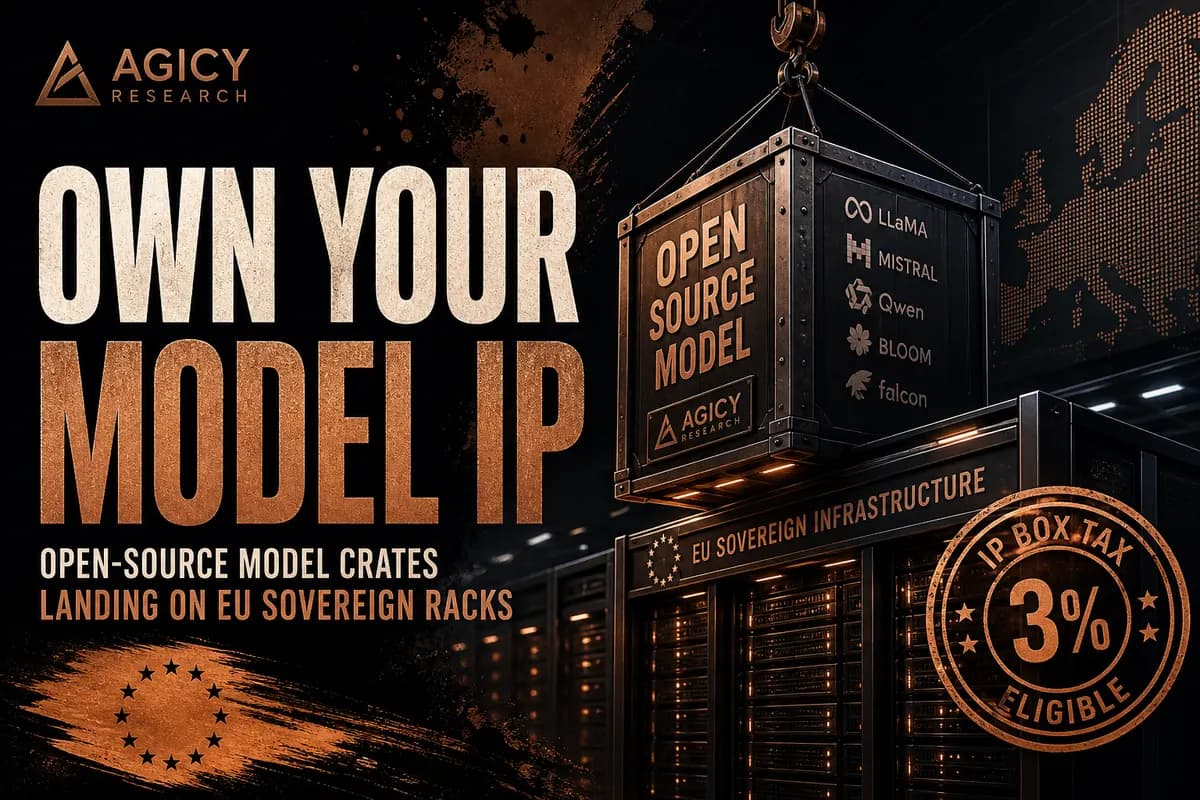
From foundation model to sovereign IP asset — subject to Cyprus IP Box nexus, ownership, and substance tests. Pick an open source model, deploy on planned RISC-V infrastructure, fine-tune with your data. The ~3% effective rate is not automatic for every model.
TL;DR
Take any open source foundation model — Llama, Mistral, DeepSeek, Qwen, Gemma, Falcon, or your own custom architecture. Deploy it on AGICY's planned sovereign RISC-V infrastructure in Cyprus, an EU member state (campus is pre-construction). Fine-tune with your proprietary data. Qualifying IP income maybe eligible for the Cyprus IP Box (~3% effective CIT) only if nexus, ownership, and substance tests are met — this is not automatic for every fine-tune, and is not tax advice.
No NVIDIA dependency by design. Structure aims to reduce US parent-company CLOUD Act exposure — not a legal guarantee. Book compute tokens via a 36-month Service Reservation Agreement (SRA) interest path, and plan R&D that may support IP Box qualification with counsel.
Cyprus IP Box provides an 80% deduction on qualifying IP income, reducing the standard 15% corporate rate to an effective ~3% when tests are met. Fine-tuned model weights and custom pipelines may qualify — counsel and modified-nexus rules decide. Not a guarantee. Campus is pre-construction.
The Open Source Model Landscape (2026)
The open source AI ecosystem has matured to the point where frontier-class models are freely available for commercial deployment. The question is no longer which model — it's where you deploy it and who owns the resulting IP. Every model below can be deployed on AGICY's sovereign RISC-V infrastructure within hours of booking SRA tokens.
| Model | Parameters | License | Best For | AGICY Zone |
|---|---|---|---|---|
| Llama 3.x | 405B | Llama Community | General reasoning, code, multilingual | Tier 2–3 SRA |
| Mistral Large | 123B | Apache 2.0 | Enterprise reasoning, EU-native | Tier 1–2 SRA |
| DeepSeek-V3/R1 | 671B MoE | DeepSeek License | Math, reasoning, code synthesis | Tier 3 SRA |
| Qwen 2.5 | 72B | Qwen License | Multilingual, tool use, agents | Tier 1–2 SRA |
| Gemma 2 | 27B | Gemma Terms | Lightweight inference, edge-to-cloud | Tier 1 SRA |
| Falcon 3 | 180B | Apache 2.0 | Multilingual NLP, document processing | Tier 2 SRA |
| BLOOM Derivatives | 176B | BigScience RAIL | Research, multilingual generation | Tier 2 SRA |
| Your Custom Model | Any | Your license | Your domain-specific use case | Any SRA Tier |
Every model above can be uploaded to the Copperway, deployed on Tenstorrent Galaxy Blackhole RISC-V servers, and fine-tuned in-place. Your data never leaves EU jurisdiction. Your fine-tuned weights become your IP.
Three Paths to AI IP Ownership
Not every deployment needs to produce intellectual property. AGICY supports three distinct deployment paths — from simple API serving to full model development — each with its own SRA tier, compliance profile, and IP implications.
Path 1: Deploy & Serve
Deploy an open source model as-is via the Copperway. No fine-tuning, no weight modification. You get full EU data sovereignty, GDPR compliance, and zero CLOUD Act exposure — but no new IP is created.
- IP created: None (base model weights are not yours)
- Tax benefit: Standard corporate rate (15%)
- SRA tier: Tier 1 — Inference-only compute allocation
- Best for: Startups needing sovereign inference without R&D overhead
- Compliance: Full GDPR/NIS2/EU AI Act deployer obligations
Path 2: Fine-Tune & Own
Start with any open source base model. Fine-tune using your proprietary data, domain expertise, or customer interactions. The delta weights — the difference between the base model and your fine-tuned version — constitute qualifying intellectual property under the Cyprus IP Box regime.
- IP created: Delta weights, adapters (LoRA/QLoRA), custom tokenizers
- Tax benefit: 3% effective rate on qualifying IP income
- SRA tier: Tier 2 — Fine-tuning + inference compute
- Best for: Companies building domain-specific AI products
- Compliance: Full regulatory stack + IP registration support
Fine-tuned model weights qualify as “qualifying IP assets” when the R&D activity (fine-tuning) is performed by or on behalf of a Cyprus tax-resident entity. The 80% deduction applies to income derived from those assets — licensing fees, API revenue, or embedded product income. Book Tier 2 SRA tokens to begin accruing qualifying expenditure.
Path 3: Build From Scratch
Train a model from scratch on AGICY infrastructure. Full architecture design, custom dataset curation, pre-training, and deployment. Every component is your IP. Maximum tax benefit, maximum competitive moat.
- IP created: Full model architecture, weights, training methodology
- Tax benefit: 3% effective rate on all model-derived income
- SRA tier: Tier 3 — Full compute allocation (training + inference)
- Best for: Funded AI labs, civil protection, regulated industries
- Compliance: Full regulatory stack + IP registration + audit trail
The Cyprus IP Box: How 3% Works
Cyprus's IP Box regime is among the most favourable in the EU for technology companies. Here's the precise mechanics of how AI model development translates to a 3% effective tax rate.
The Calculation
- Standard Cyprus corporate tax: 15%
- IP Box deduction: 80% of qualifying IP income is exempt
- Taxable portion: 20% of qualifying IP income
- Effective rate: 15% × 20% = 3%
The “nexus approach” (OECD BEPS Action 5) requires that the qualifying R&D expenditure is incurred by the taxpayer. Fine-tuning a model on AGICY infrastructure, through a Cyprus-registered entity, satisfies this requirement — the compute spend via SRA constitutes qualifying R&D expenditure.
| Jurisdiction | Standard Rate | IP Box Rate | Notes |
|---|---|---|---|
| Cyprus | 15% | ~3% effective | 80% deduction, OECD-compliant nexus |
| Luxembourg | 24.9% | ~5.2% | 80% exemption on net IP income |
| Ireland | 15% | ~6.25% | Knowledge Development Box |
| Netherlands | 25.8% | ~9% | Innovation Box |
| United Kingdom | 25% | ~10% | Patent Box (non-EU) |
What Qualifies as IP?
- Fine-tuned model weights — delta weights, LoRA adapters, full fine-tunes
- Custom inference pipelines — optimised serving code, routing logic
- Training methodologies — novel training approaches, data curation pipelines
- AI-generated software — code produced by your deployed models
- Proprietary datasets — curated, cleaned, domain-specific training data
- API products — commercial APIs built on your fine-tuned models
“Every token you spend fine-tuning is R&D expenditure. Every weight you produce is intellectual property. The infrastructure determines the jurisdiction — and the tax rate.”
Why RISC-V Matters for Model Ownership
Choosing RISC-V over CUDA is not merely a hardware preference — it's a structural decision that affects the legal status, portability, and sovereignty of your AI intellectual property.
No CUDA Lock-In
Models deployed on NVIDIA hardware accumulate CUDA-specific optimisations — custom CUDA kernels, TensorRT profiles, NCCL communication patterns — that create switching costs measured in engineering years. RISC-V's open ISA and Tenstorrent's Apache 2.0 software stack (TT-Metalium) mean your model's inference pipeline is portable by design. No proprietary runtime dependency. No vendor-controlled optimisation layer.
Portable Models
Your fine-tuned weights are stored in standard formats (safetensors, GGUF, ONNX). They can be exported, audited, and redeployed on any compatible infrastructure. The IP travels with you, not with the hardware vendor's proprietary ecosystem.
Auditable Hardware
RISC-V's open instruction set architecture enables silicon-level auditability. For regulated industries (finance, healthcare, civil protection), this means you can demonstrate to regulators exactly how your model executes at the hardware layer — a requirement that is impossible to satisfy with proprietary CUDA/x86 architectures.
EU AI Act Compliance
Article 26 of the EU AI Act requires deployers to maintain oversight and transparency over AI systems. Open-ISA hardware provides a verifiable chain from silicon to inference output. Combined with SUI blockchain compliance logging, AGICY deployments offer end-to-end auditability that proprietary stacks cannot match.
Every model deployed on AGICY can be exported in standard open formats at any time. Your weights, your adapters, your inference pipeline — all portable. No exit fees, no proprietary format traps. This is what sovereignty means at the infrastructure layer. Book SRA tokens with confidence that your IP remains yours.
The AGICY Deployment Stack
AGICY provides a vertically integrated deployment stack purpose-built for open source model deployment, fine-tuning, and IP creation on sovereign infrastructure.
| Layer | Component | Description |
|---|---|---|
| API | Copperway | OpenAI-compatible inference API. Drop-in replacement for /v1/chat/completions. Deploy any model behind a single endpoint. |
| Upload | Model Registry | Upload custom weights (safetensors, GGUF, ONNX). Version control, rollback, A/B testing between model versions. |
| Fine-Tuning | Training Pipeline | Full fine-tune, LoRA, QLoRA, DPO, RLHF. Your data stays in-cluster. Output weights are your qualifying IP. |
| Monitoring | Observability Suite | Real-time latency, throughput, token usage, cost tracking. Per-request logging for EU AI Act compliance. |
| Compliance | SUI Blockchain | Immutable audit trail for every inference request. SRA agreements, governance votes, regulatory submissions on-chain. |
| Billing | SRA Token System | 36-month Service Reservation Agreements. Book compute tokens on SUI. Predictable cost, no spot-market volatility. |
The entire stack runs on Tenstorrent Galaxy Blackhole RISC-V servers, powered by AGICY's 42MW self-generated power supply. No third-party cloud dependency. No data leaving EU jurisdiction. No US-headquartered entity in the chain of custody.
“The best model in the world is worthless if it runs on infrastructure you don't control, in a jurisdiction that doesn't protect you, under terms that aren't yours.”
From Tokens to IP: The SRA Journey
The Service Reservation Agreement (SRA) is the mechanism that converts compute reservation into qualifying IP development. Here's how the journey works from booking to revenue.
Step 1: Book SRA Tokens
Reserve compute capacity via a 36-month SRA on the SUI blockchain. Your token allocation determines your available compute for inference, fine-tuning, or training workloads. The SRA contract is immutable, transparent, and jurisdictionally anchored in Cyprus.
Step 2: Deploy Your Model
Upload your chosen open source model (or custom weights) to the Copperway. Deployment is automated — model quantisation, sharding across Galaxy servers, and endpoint provisioning happen within minutes.
Step 3: Fine-Tune with Your Data
Run fine-tuning jobs using your proprietary datasets. Every compute cycle consumed during fine-tuning is logged as qualifying R&D expenditure. The resulting delta weights are stored in your isolated tenant partition — never shared, never commingled.
Step 4: Register IP
AGICY provides documentation support for Cyprus IP registration. Your fine-tuned model, training methodology, and custom inference pipeline are registered as qualifying IP assets under the Cyprus IP Box regime. R&D expenditure records from the SUI blockchain provide an immutable audit trail.
Step 5: Earn at 3%
Revenue derived from your qualifying IP — API licensing fees, SaaS subscriptions, embedded product income — is taxed at the effective 3% rate. The 80% deduction applies automatically to qualifying income streams.
Step 6: Scale via Marketplace
List your fine-tuned model on the AGICY marketplace. Other SRA holders can consume your model via API, generating licensing revenue that qualifies for the 3% rate. Marketplace settlement occurs on-chain via SUI smart contracts.
| SRA Tier | Compute Allocation | IP Path | Tax Benefit | Best For |
|---|---|---|---|---|
| Tier 1 | Inference-only | Deploy & Serve (no new IP) | 15% standard rate | API serving, sovereign compliance |
| Tier 2 | Fine-tuning + inference | Fine-Tune & Own (delta IP) | ~3% effective rate | Domain AI products, SaaS |
| Tier 3 | Full training + inference | Build From Scratch (full IP) | ~3% effective rate | AI labs, civil protection, regulated industries |
Every month of SRA compute generates qualifying R&D expenditure, improving your nexus fraction under OECD BEPS Action 5. The longer you build on AGICY infrastructure, the stronger your IP Box qualification becomes. Early SRA adopters lock in compute pricing and maximise their cumulative qualifying expenditure.
Security & Sovereignty Architecture
Deploying open source models in the EU is only meaningful if the underlying infrastructure guarantees genuine data sovereignty. AGICY's architecture is designed to eliminate every vector of foreign jurisdiction exposure.
- No CLOUD Act exposure: AGICY is a Cyprus-incorporated entity with no US parent company, no US subsidiary, and no US legal nexus. US law enforcement cannot compel data disclosure under the CLOUD Act.
- GDPR-native: All data processing occurs within EU territory on EU-owned infrastructure. No transatlantic data transfers. No reliance on SCCs or adequacy decisions.
- NIS2 compliant:Critical infrastructure security requirements met by design — supply chain transparency (RISC-V open ISA), incident reporting (SUI audit trail), and risk management frameworks.
- DORA compliant: For financial-sector customers, the SRA provides the contractual framework for ICT third-party risk management required under the Digital Operational Resilience Act.
- EU AI Act ready: Article 26 deployer obligations, Article 53 GPAI model transparency, and high-risk system documentation are supported out of the box.
- 42MW self-generated power: No dependency on national grid for baseline capacity. Energy sovereignty reinforces operational sovereignty.
“Sovereignty is not a feature you add later. It is an architectural decision you make at the foundation layer. Every other guarantee builds on top of it.”
Frequently Asked Questions
Can I deploy any open source model, or only pre-approved ones?
Any open source model can be deployed on AGICY infrastructure. Upload your weights in safetensors, GGUF, or ONNX format via the Copperway. There is no pre-approved model list — if it runs inference, it deploys. Models with restrictive licences (e.g., non-commercial clauses) must be used in accordance with their licence terms; AGICY does not impose additional restrictions beyond the model's own licence.
Do I need a Cyprus company to benefit from the IP Box?
Yes. The Cyprus IP Box regime requires a Cyprus tax-resident entity to own the qualifying IP and incur the qualifying R&D expenditure. AGICY can connect you with local legal and tax advisors to establish a Cyprus entity. The SRA is structured as a B2B compute agreement with your Cyprus entity as the contracting party, ensuring the R&D expenditure is properly attributed.
What happens to my model weights if I stop my SRA?
Your weights are yours. Upon SRA termination, you have a 90-day export window to download all model weights, adapters, training checkpoints, and associated data in standard open formats. No proprietary format lock-in, no exit fees. After the export window, data is securely deleted from AGICY infrastructure per GDPR data retention requirements.
How does fine-tuning on RISC-V compare to NVIDIA GPUs?
For inference workloads (serving a trained model), Tenstorrent Galaxy is competitive with NVIDIA at significantly lower power consumption. For fine-tuning workloads (LoRA, QLoRA, DPO), Galaxy supports standard training loops with TT-Metalium's ML framework. Large-scale pre-training from scratch remains more mature on NVIDIA hardware; AGICY's Tier 3 SRA is designed for organisations willing to adopt an emerging but rapidly improving training stack.
Is the 3% tax rate guaranteed, or could it change?
The Cyprus IP Box is established under Cyprus tax law (Income Tax Law, Section 9(1)(l)) and is compliant with OECD BEPS Action 5 modified nexus approach. Tax rates are subject to legislative changes; however, Cyprus has maintained its IP Box regime since 2012 and has consistently signalled its commitment to a competitive IP tax framework. The 3% effective rate is the current calculation based on the 80% deduction applied to the 15% corporate rate. AGICY recommends engaging qualified Cyprus tax counsel for specific structuring advice.
Sources & References
- 1Cyprus Income Tax Law, Section 9(1)(l) — IP Box regime providing 80% deduction on qualifying IP income. Cyprus Tax Department published guidance (2016, updated 2024).
- 2OECD BEPS Action 5 — Modified nexus approach for IP regimes. OECD/G20 Base Erosion and Profit Shifting Project, 2015. Cyprus IP Box confirmed compliant by EU Code of Conduct Group.
- 3EU AI Act, Regulation (EU) 2024/1689 — Article 26 (deployer obligations), Article 53 (GPAI transparency). Official Journal of the European Union, July 2024.
- 4NIS2 Directive (EU) 2022/2555 — Network and Information Security requirements for critical infrastructure operators. Supply chain security provisions.
- 5DORA Regulation (EU) 2022/2554 — Digital Operational Resilience Act. ICT third-party risk management framework for financial entities.
- 6US CLOUD Act (2018) — Clarifying Lawful Overseas Use of Data Act. Enables US law enforcement to compel disclosure of data held by US companies regardless of storage location.
- 7Tenstorrent Galaxy specifications — Blackhole RISC-V AI accelerators, 32 chips per 4U server, ~9 kW TDP, air-cooled. Published product materials 2025–2026.
- 8 Meta Llama 3 licence terms. Mistral AI Apache 2.0 releases. DeepSeek licence. Qwen licence. Google Gemma Terms of Use. TII Falcon Apache 2.0. BigScience RAIL licence for BLOOM.
- 9 Comparative IP Box rates: Ireland Knowledge Development Box (Finance Act 2015), Netherlands Innovation Box (Dutch Corporate Income Tax Act), Luxembourg IP regime (Law of December 2017), UK Patent Box (Finance Act 2012).
Methodology Notes & Disclosure
This guide was prepared by the AGICY Research Team for informational purposes. AGICY.AI has a commercial interest in SRA token adoption and the conclusions presented. Tax calculations are based on publicly available Cyprus tax law and OECD guidelines; they do not constitute tax advice. Model deployment capabilities are based on the current Copperway feature set and Tenstorrent Galaxy hardware specifications. Readers should consult qualified tax and legal counsel before making structuring decisions.
Last updated: July 2026. This is a living document and will be revised as the AGICY platform evolves and additional model deployments enter production.
Deploy Any Model. Plan IP Box eligibility with counsel.
Book compute tokens today. Deploy open source AI on sovereign RISC-V infrastructure. Fine-tune with your data. Own the resulting IP at the lowest effective tax rate in the EU.