GDDR6, Ethernet, and the Economics of Open AI Infrastructure
How compile-time memory prefetch and standard networking reshape datacenter TCO for sovereign AI campuses — without proprietary interconnect lock-in.
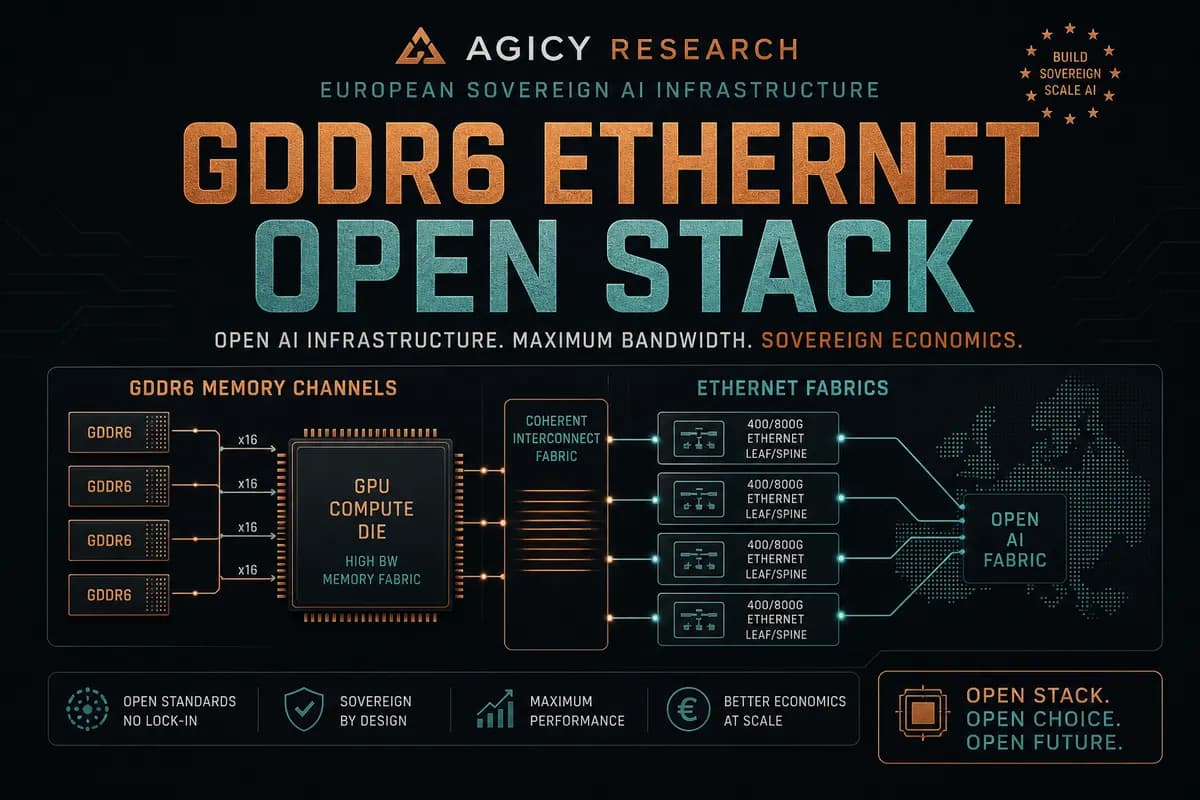
Tenstorrent's Galaxy server pairs GDDR6 memory with on-die Ethernet instead of HBM plus proprietary scale-up links. The bet: for inference-heavy, compiler-scheduled workloads, compile-time prefetch hides GDDR6 latency at a fraction of HBM BOM — while standard 400G Ethernet lets sovereign campuses scale without vendor-specific fabric contracts.
Key Takeaways
- GDDR6 economics: Lower memory BOM vs HBM; Tenstorrent argues compile-time prefetch amortises bandwidth gaps for inference graphs.VENDOR-CLAIMED
- Ethernet-on-die: Scale-out uses datacenter Ethernet rather than proprietary GPU interconnect standards.VENDOR-CLAIMED
- Galaxy unit economics:32 Blackhole chips, ~23 PFLOPs FP8, ~$110K list — air-cooled 6U form factor.VENDOR-CLAIMED
- Facility advantage:8–10 kW/rack avoids €15–25M liquid-cooling CAPEX in Phase 1 vs high-density liquid-mandatory racks.DESIGN TARGET
- Open fabric = sovereign ops: Standard switching simplifies audit, multi-vendor spares, and EU supply chain resilience.DESIGN TARGET
- AGICY fleet basis:1,801 Galaxy units @ ~$110K/unit in Phase 1 procurement model.VERIFIED
- Cross-vendor parity: When HBM-based accelerators win on TCO for a workload, AGICY deploys them — no brand loyalty.VERIFIED
GDDR6 vs HBM: A Compile-Time Trade-Off
High-bandwidth memory (HBM) dominates frontier GPU designs because it delivers extraordinary bytes-per-second — essential when runtime scheduling cannot predict access patterns. The cost is BOM, packaging complexity, and thermals: HBM stacks raise unit price and often push systems toward liquid cooling at scale.
Tenstorrent's counter-thesis for Blackhole: when TT-Forge knows the graph, memory fetches become predictable. Prefetch instructions hide GDDR6 latency; the chip spends less die area on HBM controllers and more on compute. For sustained inference — not one-off training spikes — the economics can favour cheaper memory plus smarter software.
32 Blackhole chips, 1 TB+ GDDR6 aggregate, ~23 PFLOPs FP8 peak (vendor-claimed). AGICY Phase 1 procurement models ~€102K BOM per unit in the published Galaxy specification.VENDOR-CLAIMED
Ethernet-on-Die and Open Networking
Proprietary scale-up interconnects excel at tightly coupled multi-GPU training pods — but they create fabric lock-in: switches, cables, and firmware from a single vendor ecosystem, complicating sovereign audits and spare-parts diversification.
Blackhole integrates Ethernet on die, enabling Galaxy servers to scale horizontally over the same 100G/400G Ethernet plant used for storage and management traffic. For AGICY's Vasilikos campus — and any EU facility prioritising auditable, multi-vendor networking — that openness reduces operational dependency on a single link-layer supplier.
This aligns with Phase 1 design: sovereign compute is not only about chip ISA but about whether the entire stack — from tensor compiler to top-of-rack switch — can be inspected, replaced, and certified under EU procurement rules.
Galaxy at Datacenter Scale
| Dimension | Galaxy (Blackhole) | Typical liquid GPU rack |
|---|---|---|
| Chips per server | 32 | Varies (8–72) |
| Peak FP8 (vendor) | ~23 PFLOPs | Higher peak, higher TCO |
| Cooling | Air (8–10 kW/rack) | Liquid mandatory (120+ kW) |
| Scale fabric | Standard Ethernet | Proprietary NVLink-class |
| List price (vendor) | ~$110K | $1M–3M+ per rack |
Scaling via standard Ethernet means AGICY can add Galaxy racks incrementally — matching Phase 1's 1,801-unit ramp without redesigning facility cooling or procuring proprietary switch ASICs.
AGICY Relevance
AGICY Phase 1 is the largest planned EU deployment of Tenstorrent Galaxy — 1,801 servers targeting 17T tokens/year for civil workloads (GESY healthcare, education, climate analytics).VERIFIED
GDDR6 + air cooling + Ethernet scale-out directly supports the campus economics under AGICY's vendor-neutral policy: facility CAPEX stays in Phase 1 budget without liquid retrofit, while open fabric satisfies auditability for regulated clients.
Public framing remains vendor-neutral: Galaxy is Phase 1 primary, not exclusive — alternate accelerators integrate when they pass TCO and sovereignty gates.
Model Your Sovereign Infrastructure TCO
Compare Galaxy economics against your current cloud spend — with EU jurisdiction, air-cooled density, and open networking built in.
Read RISC-V TCO AnalysisReferences & Primary Sources
- Tenstorrent — Galaxy product brief and Blackhole specifications (2026).
- AGICY Galaxy fleet specification — Phase 1 published basis.
- AGICY vendor-neutral policy — air-cooled facility economics.
- AGICY token-fleet basis note — 17T/yr public capacity basis.
- AGICY Research synthesis — Jim Keller / Blackhole video keypoints (Jul 2026).