
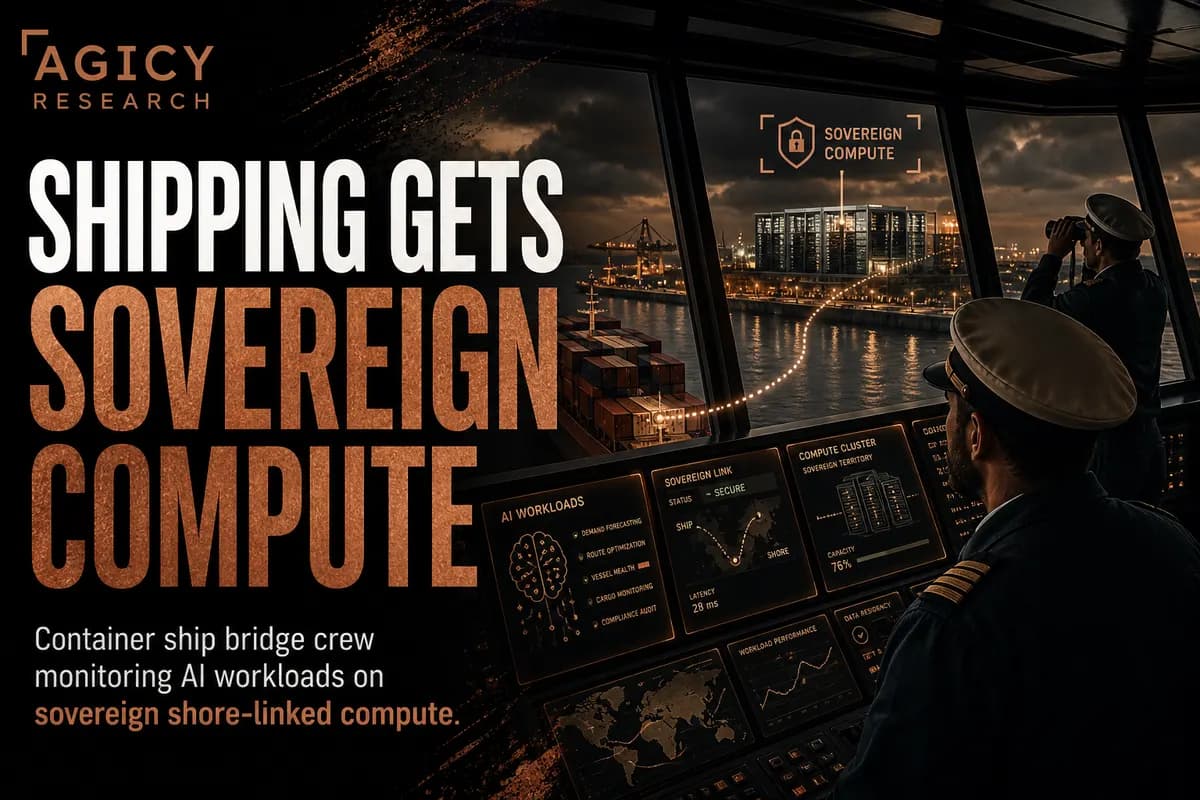

AGICY's Maritime Partner Program enables shipping associations and maritime operators to deploy sovereign AI infrastructure for fleet optimization, regulatory compliance, and predictive maintenance. Referred clients receive a 10% warrant bonus (110% of base allocation), and the partner association earns a separate 10% warrant allocation — totalling 120% issuance per deal. Maritime companies sit on massive AIS data, cargo manifests, and route optimization datasets that make them ideal sovereign compute clients. One shipping association unlocks 50–200 member companies, each with data-heavy operations averaging €480K ACV at the Growth tier.
The Maritime Opportunity: A €300B Industry Ready for AI
Global maritime shipping moves over 80% of world trade by volume. The industry generates enormous volumes of data — AIS vessel tracking, cargo manifests, port logistics, fuel consumption telemetry, weather routing, and regulatory compliance records — yet remains one of the least digitised sectors in the global economy. Most shipping companies still rely on legacy systems, manual processes, and fragmented data silos for critical operational decisions.
The current approach to AI adoption in maritime is cloud-dependent: shipping companies send sensitive operational data to US-based hyperscalers, losing sovereignty over proprietary route optimizations, cargo patterns, and competitive intelligence. For an industry where a single container line's route data represents billions in strategic value, this is an unacceptable trade-off.
AGICY's sovereign compute model changes this equation entirely. Instead of surrendering data to foreign cloud providers, maritime operators deploy AI on EU-sovereign infrastructure — training fleet optimization models, compliance engines, and predictive maintenance systems on hardware that never leaves European jurisdiction. The IP Box regime in Cyprus applies a 3% effective tax rate to qualifying AI-generated intellectual property, creating a structural advantage for maritime companies that build proprietary models on sovereign infrastructure.
The maritime industry generates over €300 billion in annual revenue globally, yet AI penetration remains below 5%. Shipping associations represent the most efficient distribution channel — one partnership unlocks 50–200 member companies, each with data-intensive operations that are ideal for sovereign AI deployment.

The Maritime Partner Funnel
The partner lifecycle follows five stages, from initial association engagement through to a sovereign maritime AI marketplace. Each stage leverages the shipping association's existing membership base, minimising acquisition cost and maximising the lifetime value of every onboarded fleet operator.
Shipping association signs partnership MOU — unlocks member fleet access
Data Score evaluation for member companies — AIS data, cargo systems, compliance readiness
First 3–5 member companies deploy sovereign AI — route optimization and compliance models
Remaining member companies onboard — full fleet AI across the association
Maritime-specific AI models published to marketplace — route, compliance, and maintenance models
The Economics: Data-Heavy Fleets, Premium Tier Revenue
Maritime companies are among the most data-intensive enterprises in any vertical. A single container shipping company generates terabytes of AIS positional data, cargo manifests, bunker fuel telemetry, maintenance logs, and regulatory compliance records annually. This data density pushes maritime clients naturally into the Growth tier (€480K ACV) — significantly higher than the average SMB client in other verticals.
| Revenue Stream | Hyperscaler Cloud | AGICY Sovereign |
|---|---|---|
| Average ACV | Variable (usage-based) | €480K Growth tier (data-heavy fleets) |
| Client Warrant Bonus | None | 110% of base (10% bonus) |
| Partner Allocation | None | Separate 10% partner warrants |
| Data Sovereignty | US jurisdiction (CLOUD Act risk) | EU-sovereign, GDPR-native |
| IP Box Benefit | N/A (US jurisdiction) | 3% effective rate (Cyprus) |
| Total Issuance | N/A | 120% of base per deal |
Example Scenario: 120-Member Shipping Association
Consider a mid-sized shipping association with 120 member companies across container shipping, tanker operations, and ship management. At a conservative 25% adoption rate, 30 member companies deploy sovereign AI through the association's partnership.
| Metric | Value |
|---|---|
| Association Members | 120 companies |
| AI Adoption Rate | 25% (30 companies) |
| Average Tier | Growth — €480,000 ACV |
| Client Warrant Allocation | 110% of base per client (10% bonus) |
| Partner Association Warrants | Separate 10% on each referred client |
| Total ACV from Association | 30 × €480K = €14.4M annual compute revenue |

Key Maritime Sectors: Where Sovereign AI Creates Maximum Value
Maritime is not a monolith. Each sub-sector has distinct data profiles, regulatory requirements, and AI use cases. AGICY's sovereign infrastructure is purpose-built to serve the full spectrum of maritime operations — from container lines operating 200+ vessels to port authorities managing thousands of daily berth allocations.
Route optimization, cargo stowage planning, demand forecasting, and schedule adherence models trained on years of proprietary voyage data.
Vetting compliance automation, charter rate prediction, weather routing optimization, and SIRE inspection preparation using sovereign AI.
Revenue management, itinerary optimization, fuel efficiency modelling, and guest experience personalization on EU-sovereign infrastructure.
Berth allocation optimization, vessel traffic management, environmental monitoring, and customs processing automation.
Supply chain visibility, intermodal routing, last-mile coordination, and cargo tracking intelligence across the logistics chain.
Predictive maintenance for main engines and auxiliaries, crew scheduling optimization, and regulatory compliance across managed fleets.
The Data Advantage: Why Maritime Is Ideal for Sovereign Compute
Maritime companies sit on some of the richest operational datasets in any industry. The combination of high data volume, strategic sensitivity, and regulatory complexity makes shipping an ideal vertical for sovereign AI deployment.
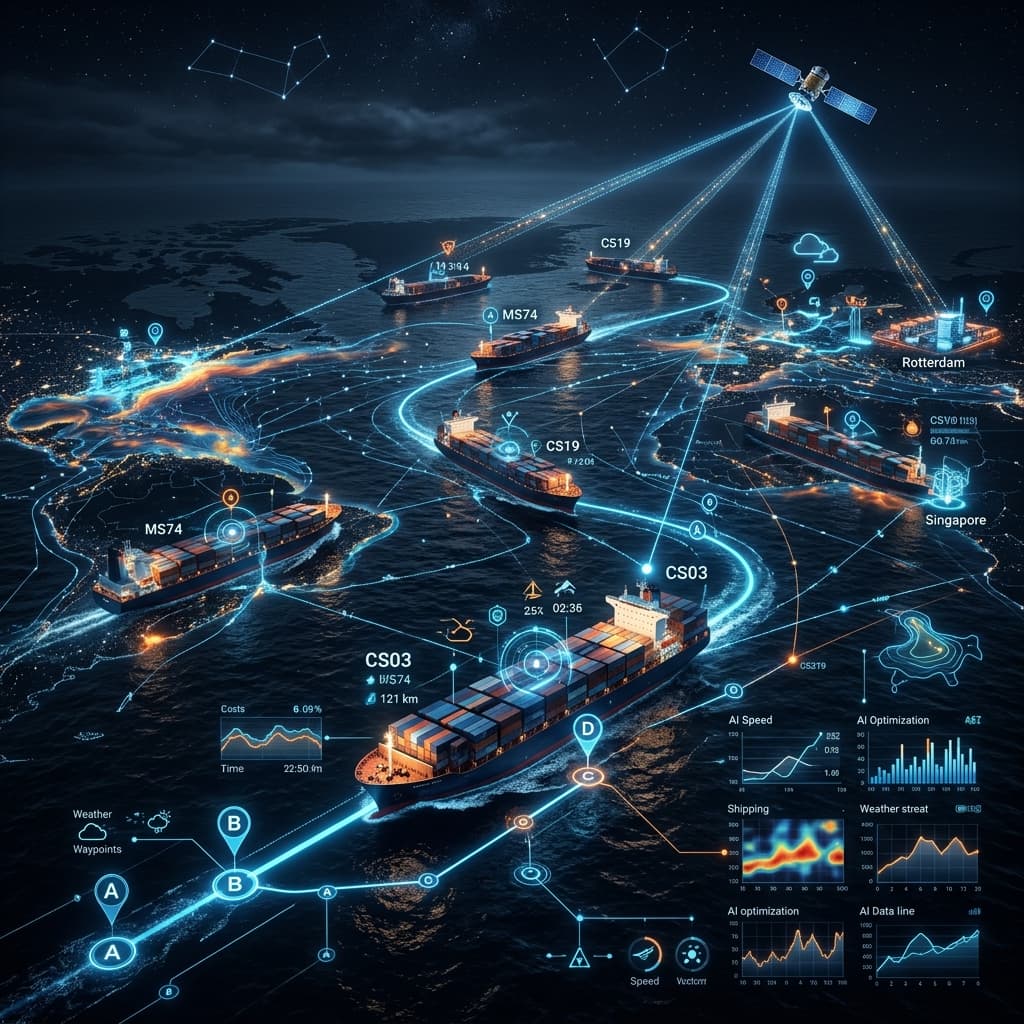
Automatic Identification System data provides real-time vessel positioning, speed, heading, and voyage patterns. When processed on sovereign infrastructure, this becomes proprietary competitive intelligence for route optimization.
Bill of lading data, container booking records, and cargo flow patterns represent strategic commercial intelligence. Sovereign processing ensures this data never feeds competitor analysis on foreign cloud platforms.
Main engine performance data, auxiliary systems monitoring, and hull stress sensors enable predictive maintenance models that reduce dry-docking costs by 15–30% when trained on sovereign infrastructure.
IMO regulations, EU ETS reporting, MRV compliance, ballast water management records, and SIRE vetting data. Sovereign AI automates compliance while keeping sensitive regulatory data under EU jurisdiction.
Maritime companies' data intensity naturally places them in the Growth tier. A single shipping company generates more data per year than dozens of typical SMB clients combined — making maritime one of the highest-value verticals for sovereign compute deployment.
Academy: Maritime-Specialised AI Training
The AGICY Academy offers a dedicated maritime track — the ACY-TOUR workshop adapted for shipping operations. This programme equips maritime professionals with the skills to deploy and manage sovereign AI across fleet operations, route optimization, and predictive maintenance workflows.
Maritime Academy Path
Sovereign AI concepts, RISC-V architecture overview, data preparation fundamentals, GDPR compliance essentials, and maritime data assessment methodology.
Fleet AI deployment patterns, AIS data processing pipelines, route optimization model design, predictive maintenance frameworks, and maritime-specific compliance automation.
Production operations for maritime AI, multi-vessel model deployment, real-time inference for navigation systems, fleet-wide monitoring, and regulatory reporting automation.
Infrastructure Capacity: First-Come, First-Served
AGICY's sovereign compute infrastructure operates on a finite node pool. The current allocation framework is built around 1,801 Tenstorrent Galaxy nodes serving a target of 248 enterprise clients. Once capacity is allocated, it cannot be shared or subdivided — maritime operators that secure nodes early lock in sovereign infrastructure before competing industries consume the remaining pool.
248 target clients across all verticals. Maritime operators compete with financial services, healthcare, legal, and other data-intensive industries for sovereign compute allocation. A single shipping association deploying 30 member companies would consume approximately 12% of the total client capacity — making early engagement critical.

Warrant Economics: 120% Total Issuance Per Deal
The maritime partnership structure creates a uniquely aligned incentive model. When a shipping association refers a member company, the client receives 110% of base warrant allocation (a 10% bonus for coming through the partner channel), and the association earns a separate 10% partner warrant allocation. Total issuance per deal: 120% of base.
| Allocation Component | Details |
|---|---|
| Client Base Warrants | 100% — standard Class D allocation at €1.22 strike |
| Client Referral Bonus | +10% — bonus for coming via partner channel |
| Partner Association | Separate 10% — earned by the referring association |
| Total Issuance | 120% of base per referred deal |
The 20% premium over base issuance (10% client bonus + 10% partner allocation) is funded by the accelerated revenue velocity that association partnerships deliver. One association onboarding 30 members generates more revenue than acquiring those 30 clients individually — the warrant premium reflects this efficiency.
Become a Maritime AI Partner
Deploy sovereign AI across your shipping association's member fleet, earn warrant-based equity alignment, and give your operators a competitive edge with EU-sovereign infrastructure — before capacity is fully allocated.