Sodium-Ion Prototypes Near 200 Wh/kg — What That Means for AI Campus Storage
pv magazine (10 Aug 2026) reviews Na-ion components approaching 200 Wh/kg. Chemistry is catching up; AGICY still banks Phase 1 on LFP.
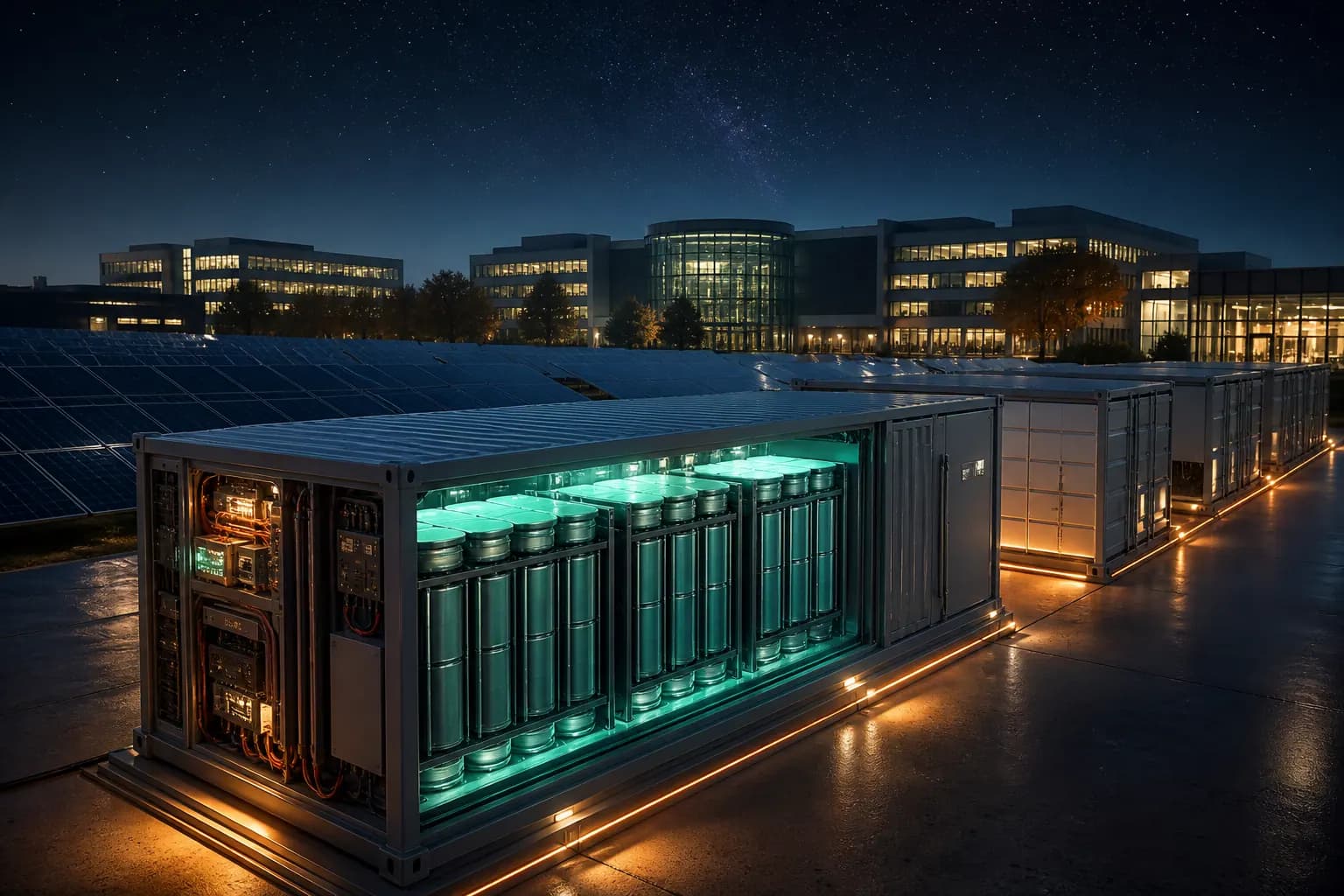
Editorial visualisation for this briefing — not a live AGICY installation and not a vendor product photo.
A 10 Aug 2026 pv magazine report on a University of South Africa / Bahir Dar / Shanghai University review states commercial SIB energy density is still ~100–160 Wh/kg, with some advanced prototypes approaching 200 Wh/kg. First-generation commercial devices (CATL, Faradion, TIAMAT) already target stationary storage. AGICY’s Phase 1 UPS remains Tesla Megablock LFP. Sodium-ion stays Phase 2+ quote-only — not a CapEx replacement.
What the 10 August 2026 review actually says
Corresponding author Ababay Ketema Worku told pv magazine that SIBs remain early-stage even as first-generation commercial devices from CATL, Faradion and TIAMAT have entered light-mobility and stationary markets. Limiters: lower energy density and shorter cycle life versus Li-ion (larger Na+ ionic radius), higher self-discharge, thin battery-grade supply chains, and manufacturing friction.
The same piece is clear on the density band: 100–160 Wh/kg today, with some advanced prototypes approaching 200 Wh/kg via electrolytes and electrodes. Thermal stability can be better than typical Li-ion, but pack-level safety still needs serious BMS / modelling. That is a materials paper, not a bankable EPC quote.
Why AI campuses should care — and not swap CapEx yet
Ember’s anytime-solar thesis is about enough storage, not a fashion chemistry. LFP Megablock (20 MWh / 10 MW planning) is the bankable bridge in AGICY’s published CapEx path. Sodium-ion’s investor pitch is abundance, no lithium in the cell, and a 2026–2027 commercial ramp (e.g. CATL TENER Sodium — China 2026, global deliveries often cited mid-2027). EU bankability and energy density still trail LFP for UPS-class halls.
Read with hail-class PV. Firm power beyond batteries is nuclear watchlist: Radiant Kaleidos, maritime SMRs, European SMRs.
Long-term vision
If Na-ion holds 200 Wh/kg-class packs with EU-warrantable cycle life, it becomes a chemistry-diversification option for later BESS tranches — lithium exposure hedge, cold-weather behaviour, potentially lower thermal-runaway surface temps. Until then it is diligence. See Anytime solar · BESS and sustainability.
FAQ
Did AGICY change CapEx because of the 200 Wh/kg prototypes?
No. Phase 1 baseline remains LFP Megablock. Sodium-ion is quote-only evaluation.
Are 200 Wh/kg cells commercially shipping?
The review describes commercial SIBs at 100–160 Wh/kg and advanced prototypes approaching 200. Treat 200 as lab/prototype, not a 2026 EPC SKU.
Related AGICY energy research
Same series — PV, batteries, US microreactors, maritime SMRs, and European SMR peers. Design-target / watchlist framing throughout. Pre-COD campus.
- Hail-Class PV for AI Datacenters — AESOLAR Alpine HW4 hail-class TOPCon as a design-target PV layer for 24/7 AI campuses — Ember anytime-solar, ≥500 kWp developer path, not a live install.
- Radiant Kaleidos and Firm Power for AI — 1 MWe portable HTGR: TRISO at INL DOME (Jul 2026), vendor commercial target ~2028. Future check — not CapEx, not COD, not EU siting.
- Maritime SMRs, Ports, and AI Load — Long Beach–MARAD MOC (28 Jul 2026) and BlueCore ~10 MWe barge SMRs. Why energy investors watching ports should also watch AI campuses.
- European SMRs vs US Microreactors — Seaborg barges, CORE POWER FNPPs, Blykalla SEALER, Thorizon, NUWARD, Rolls-Royce SMR — EU peers to Radiant/BlueCore. Watchlist, not CapEx.
Sustainability · AESOLAR Alpine stack · Energy partners ≥500 kWp · Institutional capital (not an offer)
Sources
- pv magazine — Advanced sodium-ion battery prototypes now approaching 200 Wh/kg (10 Aug 2026)
- Ember anytime solar (12 Aug 2026)
External research and vendor claims. Not AGICY offtake, CapEx, or a live campus claim. Invest page is not a securities offer.