Hardware · Tenstorrent Galaxy · Pre-COD
RISC-V Blackhole fleet
Planned Phase 1 primary silicon at AGICY Vasilikos — OEM supply, not endorsement
Thirty-two Blackhole chips per 6U air-cooled Galaxy server, Jim Keller pedigree, TT-Forge compiler-first stack, and open RISC-V ISA — no CUDA lock-in. Vendor-claimed ~300 tok/s sustained fleet average; independent diligence before procurement.
- 32× Blackhole / Galaxy
- Open RISC-V ISA
- 8–10 kW operating
- Pre-COD · OEM supply
- No TT endorsement
- Vendor-claimed figures under diligence
- EPYC host honesty
- Phase 1 · Vasilikos
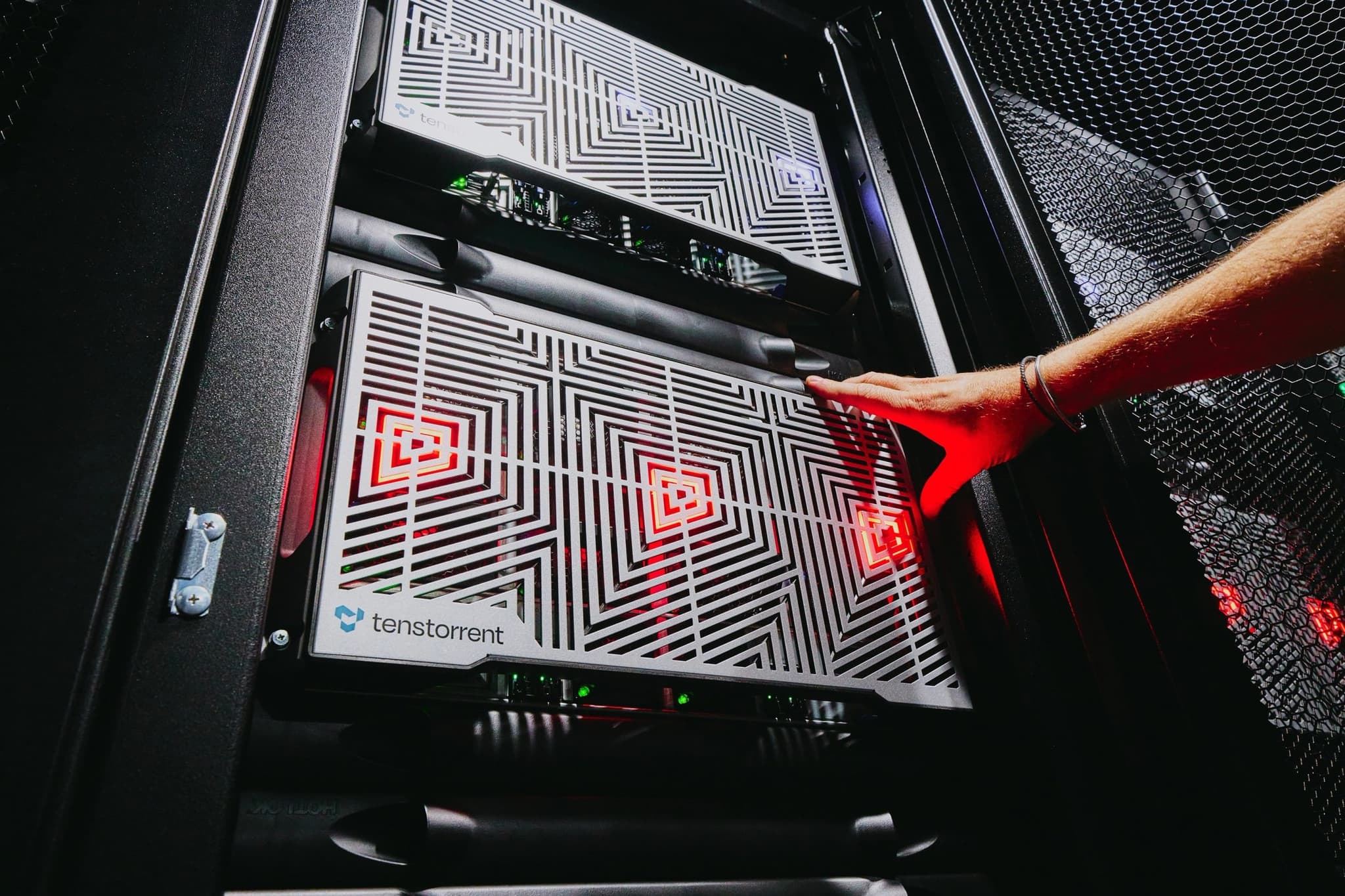 Elevation · Galaxy rack · vendor photography
How much does a Tenstorrent Galaxy Blackhole cost?
As of August 2026, Tenstorrent announced general availability of Galaxy Blackhole on 28 April 2026. Entry price is $110,000 for a 6U air-cooled system with 32 Blackhole chips. A four-Galaxy supercluster starts at $440,000. Third-party: Tenstorrent newsroom, HPCwire, The Register (28 Apr–1 May 2026).
| Item | Galaxy Blackhole | Eight-way NVIDIA DGX (trade coverage) |
|---|---|---|
| Entry / list colour | $110,000 — 6U air-cooled, 32 chips | Roughly 3–5× the Galaxy price; faster and higher capacity |
| Four-node cluster | From $440,000 | Not a 1:1 rack substitute |
| Software counterweight | TT-Metal / Tensix porting cost is real | CUDA ecosystem — omit this and the comparison is dishonest |
| AGICY campus | Planned Phase 1 fleet — not live halls | Not an NVIDIA head-term product page |
Trade coverage (The Register, 28 April 2026) placed an eight-way NVIDIA DGX system at roughly three to five times the price of a Galaxy Blackhole, while noting the DGX is faster and higher capacity. TT-Metal porting cost is the counterweight: cheaper silicon does not erase compiler and model-port work.VENDOR-CLAIMED
Can you lease Tenstorrent Galaxy hardware in Europe?
AGICY publishes a Europe lease / colo path for planned Vasilikos Galaxy capacity. Status: planned. It is not a live on-island hall. Estimates and interest live on GPU leasing Cyprus. Partner GPU Bridge rental, if offered, is partner-supplied — not campus MW.
Hardware video briefing
Seven-chapter TTS briefing on Keller pedigree, compiler-first architecture, Blackhole specs, GDDR6 facility economics, Ethernet scale-out, benchmarks, and diligence risks. This is Aphrodite, an AI agent — not a human spokesperson.
Jim Keller & engineering pedigree
Diligence signal from silicon leadership — not an endorsement of AGICY's model or Tenstorrent as a strategic partner.
Blackhole silicon is led by Jim Keller— architect of AMD Zen, Apple mobile SoCs, and Tesla Autopilot hardware. Keller's public thesis: predictable AI workloads favour systems you can plan, audit, and operate at facility scale.VERIFIED
AGICY cites Keller's pedigree as a diligence signal, not an endorsement. Tenstorrent is an OEM-tier hardware supplier per silicon partner compliance framing.VERIFIED
Compiler-first alternative
Tensor movement planned at compile time for structurally predictable graphs — batch inference, fixed-graph serving, civil chatbots.
Tenstorrent positions TT-Forge as compiler-first: tensor movement planned at compile time for structurally predictable graphs — batch inference, fixed-graph serving, civil chatbots.VENDOR-CLAIMED
Deep dive: The Compiler-First Challenge to GPU Orthodoxy.
Why RISC-V is strategic — not a side bet
Accelerators plus host CPU IP — open ISA economics, co-design leverage, and a second business line if AI-chip timing slips.
Tenstorrent builds AI accelerators across the Wormhole → Blackhole line and invests in RISC-V host CPU IP. That is not a distraction from AI: every accelerator still needs a host CPU to boot, schedule, and feed work. ARM and x86 carry per-unit licensing economics; RISC-V is an open, royalty-free ISA — a structural cost and control advantage for anyone designing full systems.VERIFIED
Owning both sides of the CPU↔accelerator interface lets a vendor define the coupling — custom instructions, tighter data movement, fewer black-box handoffs — the same co-design instinct behind Apple's M-series thesis, applied to open silicon rather than a closed SoC.VENDOR-CLAIMED
Outside the datacenter CUDA fortress, RISC-V traction is strongest where openness and sovereignty matter: edge and IoT, automotive, and government programmes across India, China, and the EU. RISC-V International's multi-thousand-member ecosystem compounds that leverage — more toolchains, more IP, more procurement options — versus a proprietary ISA gatekeeper.VERIFIED
Strategically, CPU/IP work is also a second business line if AI-chip timing slips. Execution still rides on Keller-led delivery, SDK maturity, and supply continuity — standard diligence, not a free option.DESIGN TARGET
Next: Galaxy vs Cerebras →
Galaxy vs Cerebras — different problems
Tenstorrent and Cerebras are both NVIDIA alternatives. They do not solve the same problem.VERIFIED
Tenstorrent Galaxy
- Modular network-of-chips: 32× Blackhole per 6U server, Tensix mesh, GDDR6, on-die Ethernet scale-out on commodity fabricVENDOR-CLAIMED
- Open RISC-V software path; air-cooled inference economics for Phase 1
- Sovereign batch and civil inference at fleet scale
Cerebras CS-3
- Wafer-scale engine: one giant SRAM-rich die for frontier training and ultra-high per-user throughputVENDOR-CLAIMED
- Liquid-cooled, denser facility fit — Phase 2 optionality at Vasilikos
- Not a Galaxy substitute — complementary workload path
AGICY routes by workload: Galaxy for sovereign batch and civil inference at fleet scale; CS-3 where wafer-scale training or latency gates win. Neither vendor endorses AGICY's model — both are silicon supply options under diligence.VERIFIED
Cerebras CS-3 hardware page → · IBM z17 → · AMD Helios → · d-Matrix Corsair →
Blackhole architecture & Galaxy server
Thirty-two Blackhole chips per air-cooled 6U Galaxy — Phase 1 nameplate fleet economics under diligence.
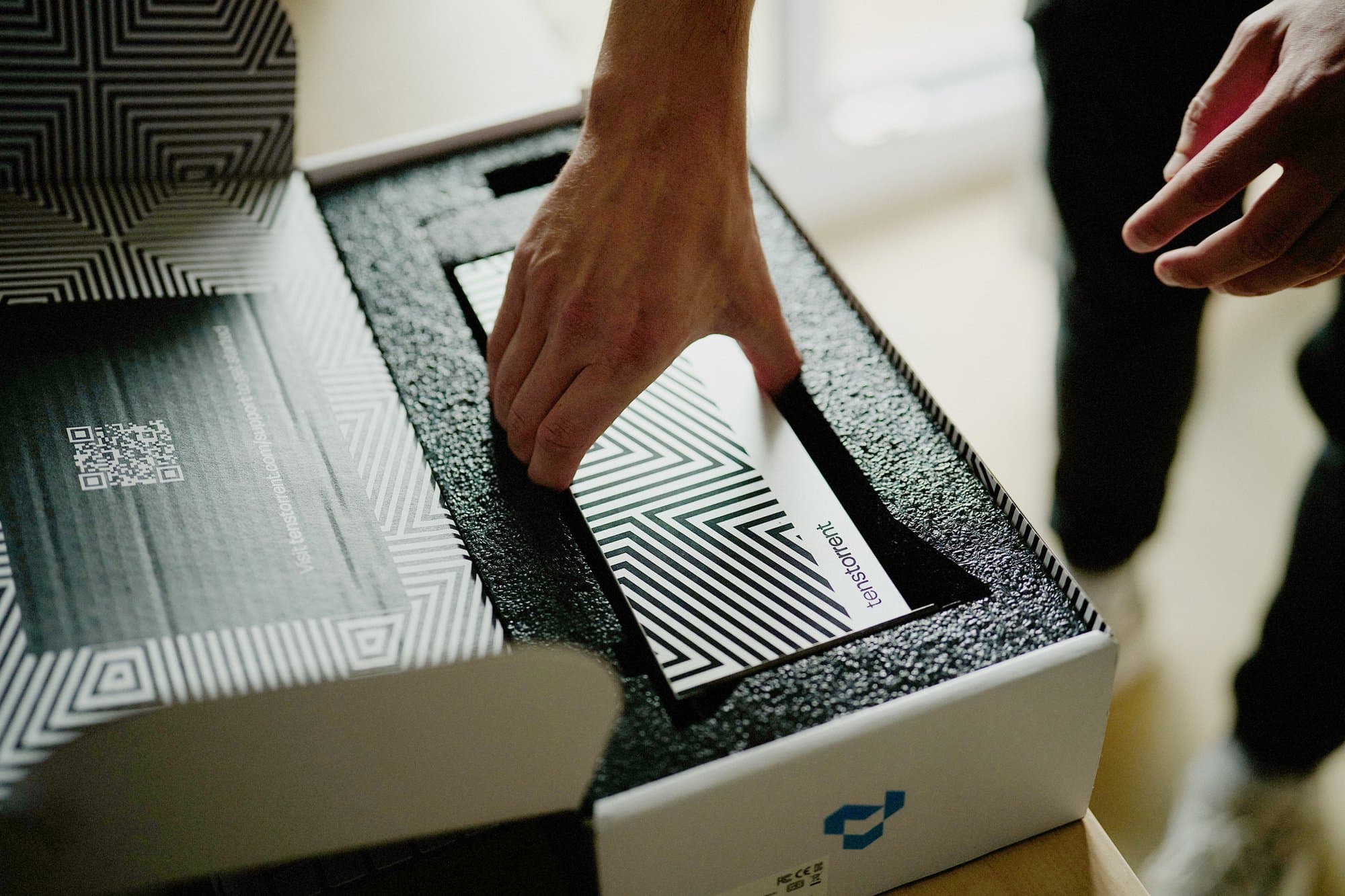
- 32× Blackhole per Galaxy — 16 Linux-capable RISC-V cores + ~752 baby RISC-V cores per chip; matrix compute is Tensix enginesVENDOR-CLAIMED
- ~19,200 mm² silicon (~600 mm²/die, roadmap neighbourhood; die area, not core area)DESIGN TARGET
- ~23 PFLOPs FP8, ~$110K list per serverVENDOR-CLAIMED
- 8–10 kW operating air-cooled (not nameplate; ~12 kW max). Fleet IT 16.2 MW · wall 19.5 MW at PUE 1.20 TARGETVERIFIED
- Phase 1: campus-class MW programme → throughput targets at procurement lockVERIFIED
GDDR6 & Ethernet scale-out
Air-cooled memory economics and commodity fabric — facility TCO without proprietary link layers. Vendor solution demos below illustrate realtime video and LLM inference workloads (marketing, not AGICY production).
Galaxy uses GDDR6external memory; vendor-claimed compile-time prefetch amortises latency for predictable inference. Facility TCO favours air-cooled racks without liquid retrofit CAPEX in Phase 1.VENDOR-CLAIMED
GDDR6, Ethernet, and Open AI Infrastructure Economics →
On-die Ethernetenables Galaxy clusters on standard datacenter fabric — auditable networking without proprietary link layers. Fifty-six × 800G paths per server (vendor-claimed 11.2 Tb/s aggregate).VENDOR-CLAIMED
Galaxy & DeepSeek benchmarks
Vendor-claimed ~350 tok/s on DeepSeek-R1-class inference; EE Times independent pre-launch: 255 tok/s. Plan with 255–350 tok/s until AGICY SC-36 benchmarks publish.VENDOR-CLAIMED
| Metric | Galaxy (32× Blackhole) | NVIDIA B200 (8× GPU) |
|---|---|---|
| Sustained tok/s (planning) | 255–350 | Varies by config |
| Power | 8–10 kW operating (air) | Liquid-cooled |
| ISA / stack | Open RISC-V | CUDA |
| List price (server) | ~$110K | ~$3.7M+ (DGX class) |
Open stack & diligence risks
Open ISA, PyTorch, and Hugging Face reduce runtime lock-in — standard pre-production risks remain.
Open ISA, PyTorch, and Hugging Face reduce runtime lock-in. Standard pre-production risks: SDK maturity, yield, firmware, leadership continuity, supplier concentration.DESIGN TARGET
AGICY relevance
Phase 1 sovereign inference fleet (pre-COD) — OEM supply under diligence, not a Tenstorrent endorsement.
Related research
Interested in Leasing?
Lease or finance Galaxy units on AGICY premises, or at your site if it meets our T&Cs. Free estimate for integration and delivery. Install / network path offered Pre-COD; 24/7 support and model training later as ops mature. Leasing ≠ SRA / CY tokens.